Retrieval-augmented generation with LlamaIndex
We design and tune RAG pipelines that ground LLM answers in your own data — from chunking strategy and embeddings to hybrid search, reranking, and evaluation — so answers cite sources instead of guessing.
What a good RAG system does
RAG is not a single trick — it's a stack of design choices, each one measurable and tunable against your data.
Chunking strategy
Semantic, structural, and window-based chunking tuned to your document types — the single biggest quality lever.
Embedding & re-embedding
Pick embedding models on quality vs cost, plan versioning, and re-embed cleanly as content or models change.
Vector store choice
Pinecone, Weaviate, pgvector, or Elastic — chosen on scale, filtering needs, and how much infrastructure you want to run.
Hybrid search (BM25 + vector)
Combine keyword and vector retrieval so exact terms, acronyms, and semantic paraphrases all win the right chunks.
Reranking & scoring
Cross-encoder rerankers and score thresholds cut noise and keep low-quality retrievals out of the final prompt.
Answer grounding
Answers cite the retrieved chunks, and prompts refuse to invent when retrieval comes up empty.
From raw content to grounded answers
A four-phase engagement that treats retrieval as an engineering problem, not a black box.
Data audit
We inventory your sources, their structure, freshness, and access rules — the foundation every choice downstream rests on.
Index design
Chunking, embeddings, metadata schema, and vector store selected against your query shapes and data volumes.
Retrieval tuning
A retrieval eval set drives iteration on hybrid weights, reranking, and query rewrites until top-k is right.
Evaluation & rollout
End-to-end answer evaluation, citation checks, and staged rollout behind flags with monitoring for drift.
The RAG stack we build on
Frameworks and stores chosen for retrieval quality, operational maturity, and cost at your scale.
Where RAG earns its keep
Retrieval-first architectures shine when answers must cite your data, not a model's pre-training.
Product docs Q&A
A grounded assistant over your docs, changelogs, and API references — cited answers that stay in sync with releases.
Sales enablement search
Reps ask natural questions across decks, battlecards, and call notes and get the exact slide or paragraph.
Contract & legal review
Query clauses across a contract library with the source clause and section number returned alongside the answer.
Support knowledge base
Agents and end-users get grounded answers over KB articles, past tickets, and product docs, with citations.
Compliance & policy lookups
Policy assistants that quote the exact clause and version, so answers pass an internal audit.
Internal wiki assistants
A search-and-ask layer over Confluence, Notion, or Google Drive that respects existing access controls.
Why teams invest in RAG
A well-tuned retrieval layer changes what an LLM feature can safely be used for.
Answers grounded in your data
Responses cite your own documents, so the LLM stops speaking on topics outside your knowledge base.
Lower hallucination rate
Retrieval, reranking, and refusal-when-empty push hallucination down to a rate you can measure and improve.
Auditable citations
Every answer links back to the source chunks, so reviewers and end-users can verify without guesswork.
Costs scale with usage
Retrieval keeps prompts compact, so per-query cost stays flat as your knowledge base grows.
RAG in production
A retrieval pipeline built and tuned against real support content.
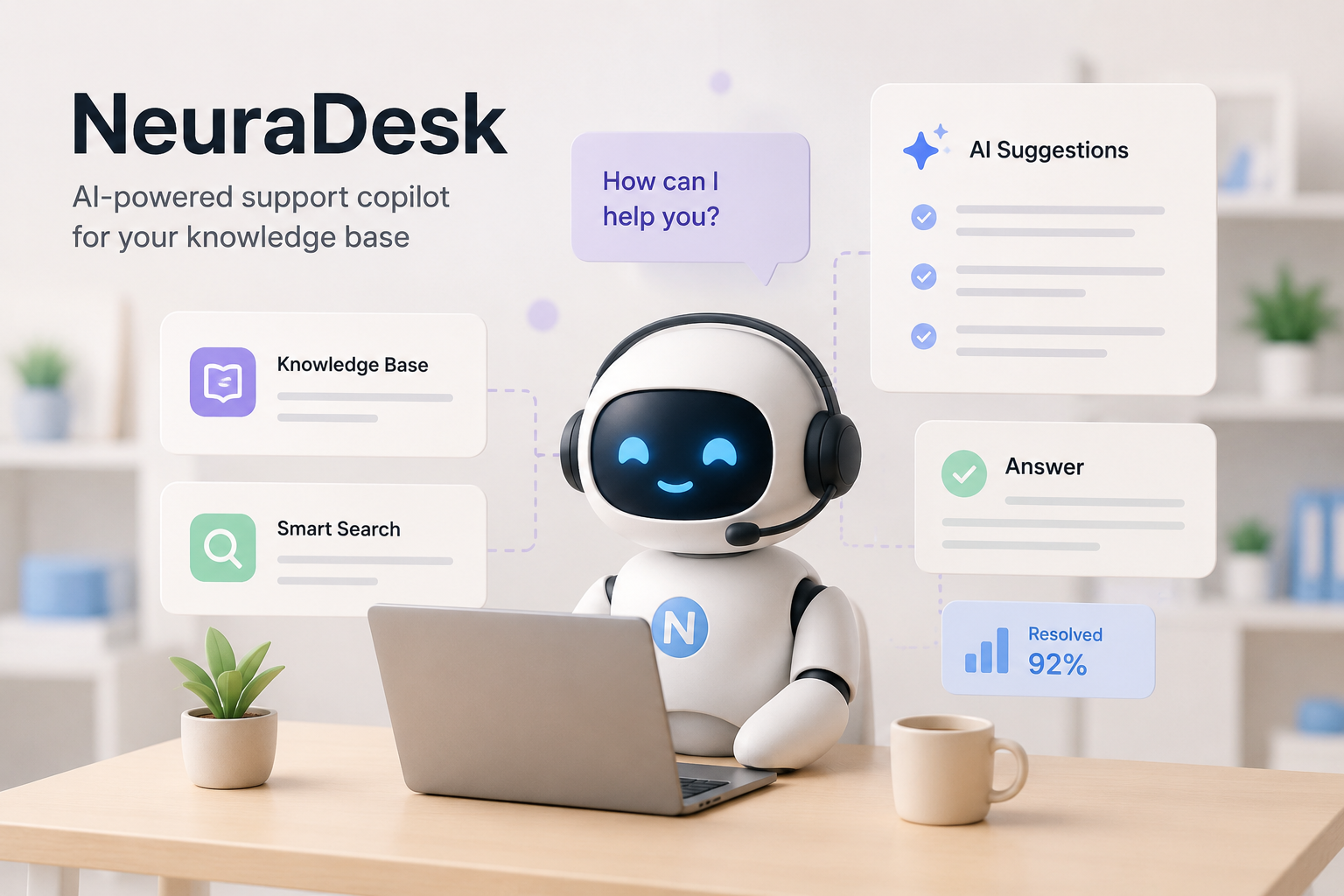 AI • RAG
NeuraDesk
A retrieval-augmented support copilot that grounds answers in a company's own knowledge base.
Read Case Study →Why teams pick us for RAG
Retrieval-first engineers who've tuned real pipelines against messy, mixed-format data.
Learn more about us →We tune retrieval, not just prompts
Most quality wins come from chunking, hybrid weights, and reranking. That's where we spend our time.
Evaluation on retrieval itself
A retrieval eval set lets us tell whether top-k is actually right before we touch the answer prompt.
Own the outcome end-to-end
From ingestion to serving to monitoring, one team stays with the pipeline through the operational tail.
Own your stack — no vendor lock-in
Indexes, embeddings, and eval sets live in your accounts. Swap vector stores or embedding providers without a rewrite.
RAG questions we hear most
Practical answers on the design choices that decide whether a RAG system works.
What are the biggest chunking gotchas?
Which vector database should we use?
Hybrid search or pure vector?
How do we keep the index fresh?
How do we handle multi-tenant isolation?
How do you evaluate retrieval quality?
Ready to ground your LLM in real data?
Bring your content and a target use case. We'll come back with an index design and a retrieval evaluation plan.
Book a Discovery Session →