Autonomous agents that own the task end-to-end
We design agents that reason through multi-step work, take real actions in your systems, and escalate to humans when confidence drops.
Agents built for trust and control
Autonomy is a spectrum. We give you the dials — where the agent decides, where it asks, and where it stops.
Task decomposition
The agent breaks a request into subtasks with dependencies, so you can inspect and edit the plan before it executes.
Tool inventory & permissions
A declared registry of tools with input schemas and scoped credentials — the agent can only call what you allow.
Reasoning traces
Every step, tool call, and intermediate result is logged with prompts and outputs — auditable weeks after the fact.
Confidence gating
When a step's confidence falls below a policy threshold, the agent pauses, retries with a stronger model, or hands off.
Escalation to humans
A reviewer queue with the task history, the proposed action, and one-click approve, edit, or reject.
Budget & step limits
Per-task caps on tokens, tool calls, and elapsed time — enforced by the runtime, not by prayer.
From modeled task to supervised production
A four-phase engagement that treats autonomy as a design constraint, not a feature to celebrate.
Task modeling
We diagram the task the way a senior operator would run it — inputs, decision points, tools, and the acceptable end state.
Guardrails & tools
Tool schemas, allowed data sources, rate limits, and safe-completion rules are written down before the agent runs once.
Adversarial eval
We build a test suite of ambiguous, malformed, and hostile inputs — and require the agent to fail cleanly on each.
Rollout with human oversight
Shadow mode, then supervised mode, then autonomous mode for the safest task classes — each promotion gated on metrics.
Agent runtime
The orchestration frameworks, model providers, and execution infrastructure we use to run agents you can trace.
Where agents earn their keep
Repetitive multi-step work with clear inputs, defined success criteria, and a human ready to take the last mile.
Research & competitive intel
Agents that browse, extract, and synthesize public information into structured briefs on a schedule you set.
Data cleaning & enrichment
Deduplicate, normalize, and enrich records against internal and external sources — with per-row confidence scores.
Ticket routing & first-touch
Classify inbound tickets, draft an initial response, and either resolve simple cases or route with full context to a specialist.
Vendor procurement checks
Run a supplier through a checklist — sanctions, financials, security posture — and produce a decision packet for review.
Compliance review triage
Read a policy artifact, flag clauses that need a human, and draft a memo the reviewer only needs to correct, not write.
Reporting pipeline agents
Assemble weekly and monthly reports from the systems of record — with commentary drafted from the numbers themselves.
What supervised agents deliver
The measurable difference between a chatbot and an agent is the work that comes back finished.
Cycle time cut on repetitive work
Tasks that used to sit in a queue for hours or days finish in minutes, with a human only for the final approval.
Fewer handoff errors
The agent carries state end-to-end — no dropped context between shift changes, teams, or ticket systems.
Traceable decisions
Every action ties back to inputs, tool outputs, and the reasoning behind it — usable for audit and for training the next version.
Bounded cost per task
Budgets and step limits give finance a per-task ceiling they can plan against, not a bill they explain after.
Agent-shaped work in the wild
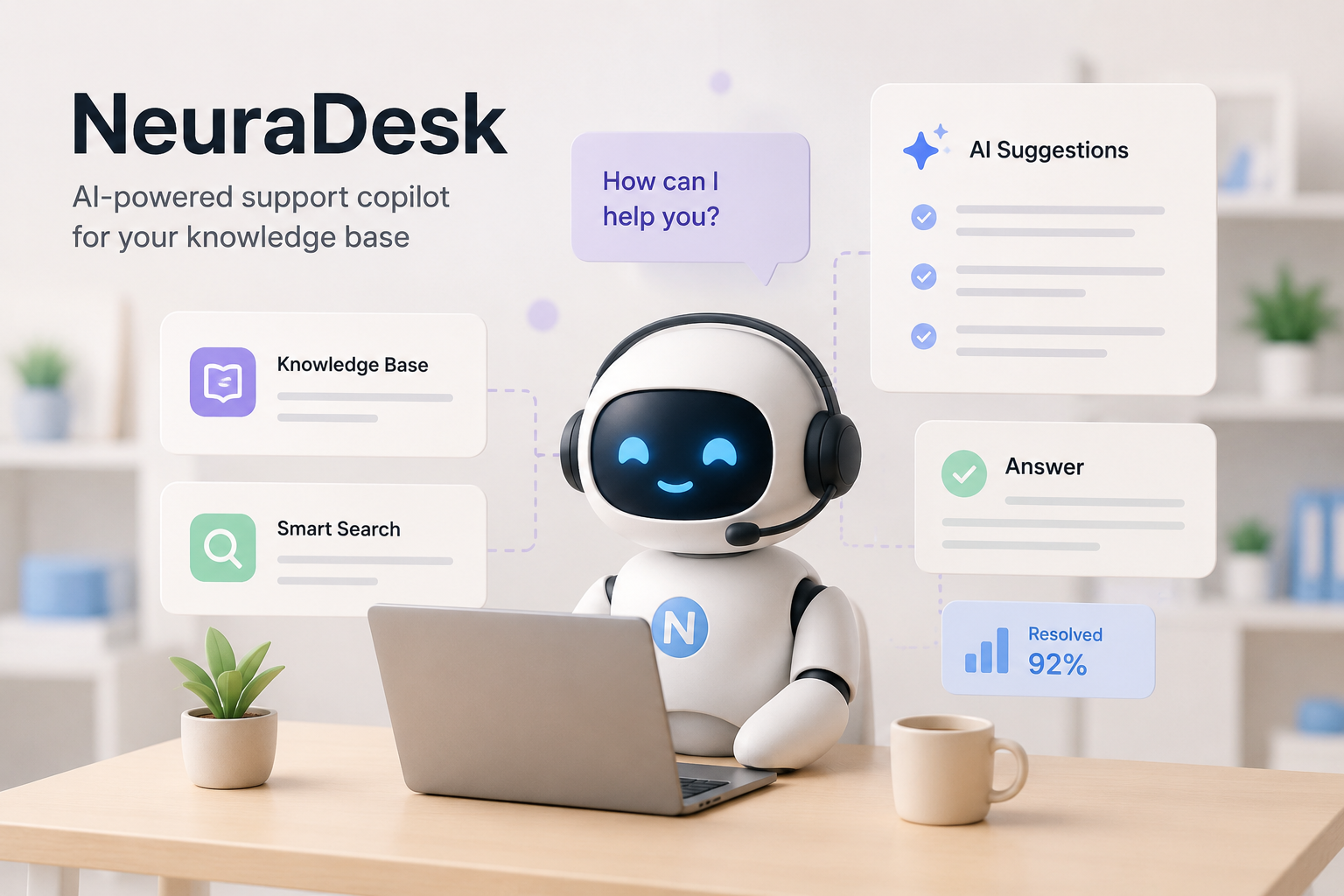
NeuraDesk demonstrates the retrieval, tool-calling, and evaluation loop we reuse for supervised agents.
 AI • RAG
NeuraDesk
A retrieval-augmented support copilot that grounds answers in a company's own knowledge base.
Read Case Study →Why teams choose us for production agents
Building an agent that works once is an afternoon. Building one that works on Monday morning is what we do.
Learn more about us →Autonomy sized to the risk
We map every task to a safe autonomy level — from suggestion to fully autonomous — and gate the promotion path on evidence.
Observable by design
Traces, prompts, and tool payloads are captured from the first run so debugging never depends on memory or guesswork.
Failure-first evaluation
We test the ways the agent should fail — hallucinated tools, missing fields, hostile inputs — before we test the happy path.
Portable orchestration
Framework choices you can walk away from. The task graph, tools, and evaluations remain yours.
Agent questions we get
What security, operations, and product leaders raise when they consider giving an agent the keys.
How do you keep an agent from taking a destructive action?
Where do you draw the line on autonomy?
What does human review look like day to day?
How predictable is the cost per task?
What does monitoring look like once the agent is live?
Can the agent use our existing systems?
Give an agent a real job and see it finish.
Tell us the task and the systems it needs to touch. We'll come back with a plan, a safety model, and a target success rate.
Book an Agent Discovery →