Agentic AI systems built on LangGraph
We design multi-step, tool-using AI agents that plan, act, and self-correct — from research assistants to autonomous back-office workflows — using LangGraph, LangChain, and evaluation-first engineering.
What an agentic system actually does
A production agent is more than a prompt. It plans, calls tools, tracks state across turns, defers to humans when unsure, and gets measured against a real evaluation set.
Planning & task graphs
Break a goal into a directed graph of steps, branches, and retries — deterministic where you can, LLM-driven where you must.
Tool use & function calling
Give agents typed tools — search, database, APIs, code execution — with schema validation and structured error handling.
Memory & state
Short-term working memory and long-term stores keep agents coherent across turns, sessions, and multi-user contexts.
Human-in-the-loop review
Escalation, approval gates, and edit-in-place review let humans stay in charge of high-risk actions.
Evaluation harnesses
Golden sets, regression suites, and LLM-as-judge scoring turn agent quality into a number you can move over time.
Observability & tracing
Every run traced end-to-end — prompts, tool calls, tokens, latency — so debugging a bad answer takes minutes, not days.
From workflow sketch to production agent
A four-phase engagement that keeps stakeholders close and puts evaluation in the critical path from week one.
Discovery & guardrails
We map the target workflow, its inputs and failure modes, and define what the agent is allowed and forbidden to do.
Graph design & tools
We model the task as a LangGraph, wire the tools and memory, and stand up a working prototype against real data.
Evaluation loops
A golden set and automated scoring drive iteration — prompts, models, and tool schemas change until quality holds.
Production rollout & monitoring
We ship behind feature flags, wire tracing and cost dashboards, and set up alerts for drift and regression.
The agent stack we build on
Modern frameworks paired with the observability and infrastructure that keep agents reliable in production.
Where agentic AI earns its place
Agents work best where a workflow has clear inputs, tool-callable steps, and a measurable outcome.
Support triage agents
Classify, route, and draft replies for incoming tickets — with escalation to a human on low confidence.
Data-room research assistants
Ingest deal rooms and long-form reports, then answer diligence questions with grounded citations.
Sales-ops copilots
Enrich accounts, summarize calls, and update the CRM through structured tool calls, not screen scraping.
Compliance workflows
Read incoming documents, check them against policy, and produce a review-ready audit trail.
Ops runbook automation
Turn internal runbooks into agents that diagnose alerts, run safe remediation, and page humans on ambiguity.
Analyst deep-research
Multi-step research over web, internal data, and structured sources, delivered as a cited briefing.
Outcomes that justify the investment
Well-scoped agents move throughput, quality, and audit-readiness at the same time.
Faster task cycle time
Manual multi-step work collapses into minutes, with humans reviewing exceptions instead of doing every case.
Higher answer accuracy
Grounded tool use and evaluation-driven prompts keep answers tied to real data, not model guesswork.
Auditable decisions
Full traces of prompts, tool calls, and outputs give compliance and QA a clear record for every run.
Predictable rollout
Feature flags, canaries, and eval-gated releases let you expand scope without surprise regressions.
See an agent in production
A grounded, tool-using assistant built for support workflows.
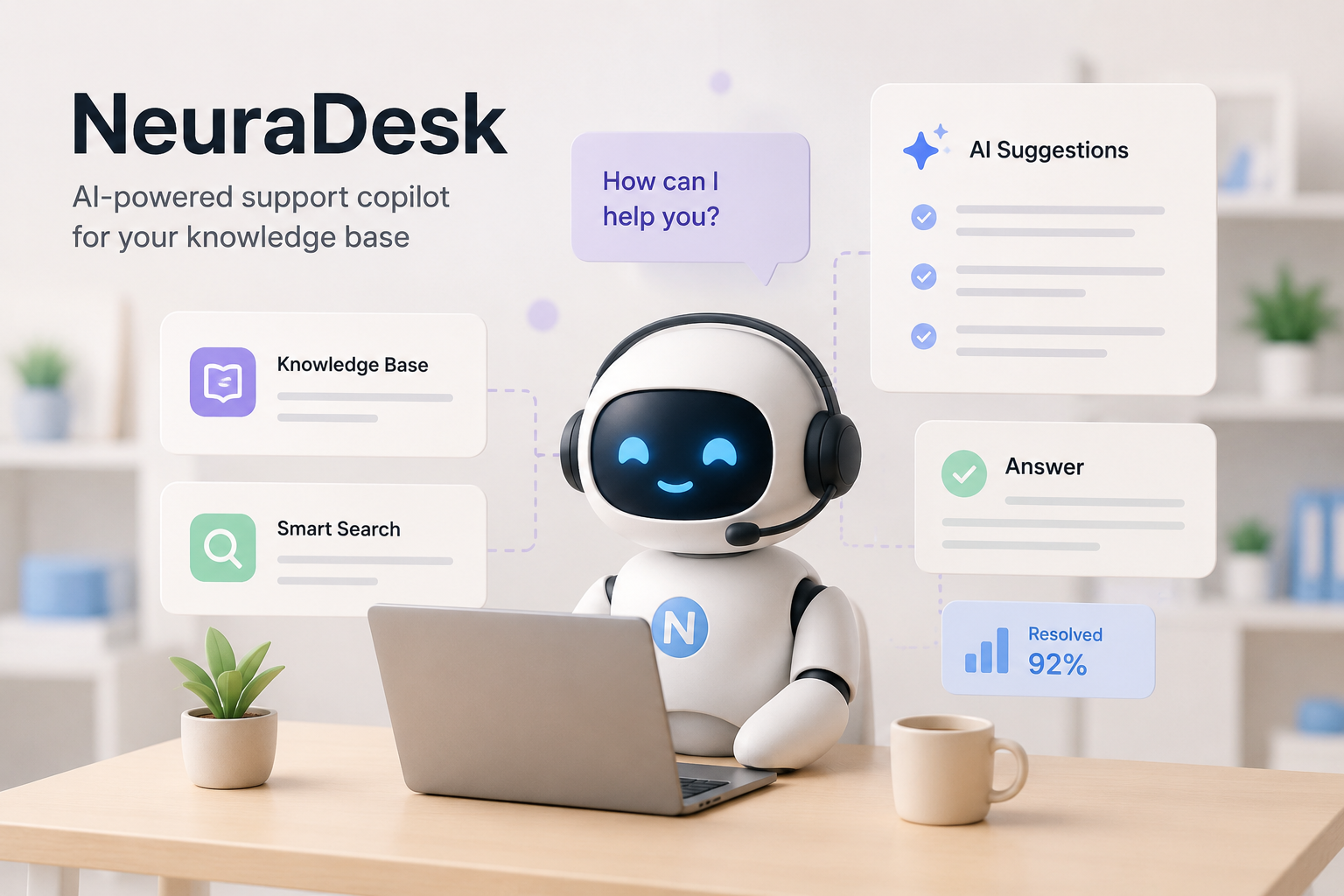 AI • RAG
NeuraDesk
A retrieval-augmented support copilot that grounds answers in a company's own knowledge base.
Read Case Study →Why teams pick us for agentic AI
A senior team that has shipped agents to production and stayed with them through the operational work that follows.
Learn more about us →Senior AI engineers, no telephone game
You work directly with the engineers designing the graph, not through layers of account management.
Evaluation-driven from day one
We define a scoring rubric before we write the first prompt, so every change is measured against it.
Own the outcome end-to-end
Discovery, design, integration, rollout, monitoring — one team accountable across every phase.
Own your stack — no vendor lock-in
Code lives in your repos, models are swappable, infrastructure is documented, and you keep the keys.
Questions teams ask us first
Practical answers on safety, cost, and how agentic systems actually go to production.
How do you keep an agent from doing something it shouldn't?
How do you deal with hallucination?
How do you control token cost?
Where does the agent run?
How do you evaluate an agent before shipping?
Can it integrate with our existing systems?
Ready to design your first production agent?
Book a working session and we'll map a first agent to a concrete workflow in your business.
Book a Discovery Session →