Fine-tuned models for domain accuracy and cost
We fine-tune open-source and hosted models — SFT, LoRA / QLoRA, and preference tuning — with curated datasets, honest evaluation, and deployment on serving stacks that hold up under real traffic.
What fine-tuning actually involves
Fine-tuning is a pipeline — dataset work, training, evaluation, and serving. Get any one wrong and the model regresses.
Dataset curation
Sourcing, cleaning, deduplication, labeling, and licensing checks — dataset quality is the ceiling on model quality.
SFT & instruction tuning
Supervised fine-tuning on instruction / response pairs, with masking and packing strategies that fit your data shape.
LoRA / QLoRA adapters
Parameter-efficient tuning that fits in modest GPU budgets and lets you keep multiple task adapters on one base.
DPO / preference tuning
Preference optimization from chosen / rejected pairs — cheaper and more stable than full RLHF for most tasks.
Eval harnesses
Task-specific evals plus general capability benchmarks so you catch regressions on core skills, not just wins on your task.
Deployment & serving
Model packaging, vLLM / TGI serving, adapter hot-swapping, and autoscaling built for the traffic profile you actually have.
From base model to production weights
A four-phase engagement that respects the fact that most fine-tuning value is in the data and evaluation, not the training.
Data & task audit
We map the target task, sample the data, and decide whether fine-tuning is the right lever — sometimes better prompting or RAG wins.
Prep & training runs
Dataset cleanup, base model selection, and structured training runs on managed GPU infrastructure.
Evaluation loop
Task evals, capability regression checks, and A/B against the base model until improvements are real, not just visible.
Serving & monitoring
Package the weights, deploy on vLLM or TGI, wire monitoring, and set up a re-training path as data changes.
The training stack we build on
Frameworks and infrastructure chosen for training throughput, cost control, and honest evaluation.
When fine-tuning is the right call
Fine-tuning pays off when prompting hits a ceiling, cost is a bottleneck, or data policy requires a model you control.
Domain-specific chat models
A smaller open model that speaks your product, your terminology, and your compliance rules fluently.
Structured extraction
Reliable JSON, XML, or schema-conformant outputs on documents that off-the-shelf models keep getting wrong.
Style & tone adaptation
Models that match a house voice for support, legal, or marketing without a wall of few-shot examples in every prompt.
Function-calling accuracy
Higher tool-call precision on a fixed set of internal APIs than a general-purpose model reliably delivers.
Low-latency small models
A tuned 7B or 13B model that meets your quality bar and serves at a fraction of the cost and latency of a frontier API.
Sensitive on-prem models
Regulated data, air-gapped environments, or export controls where a model you host on your own hardware is the only option.
Why teams fine-tune
Fine-tuning trades upfront training investment for durable gains on cost, latency, and control.
Lower inference cost
A tuned smaller model can match a frontier model on a narrow task at a fraction of per-token cost at scale.
Faster response times
Smaller weights and dedicated serving cut tail latency in ways prompt engineering on a hosted API cannot.
Higher domain accuracy
On narrow tasks with real training data, a tuned model beats prompt-engineered generalists on both quality and consistency.
Data stays in your VPC
Training and inference on your infrastructure means sensitive data never crosses a third-party API boundary.
AI systems in production
A grounded LLM product built on retrieval and evaluation-driven engineering.
 AI • RAG
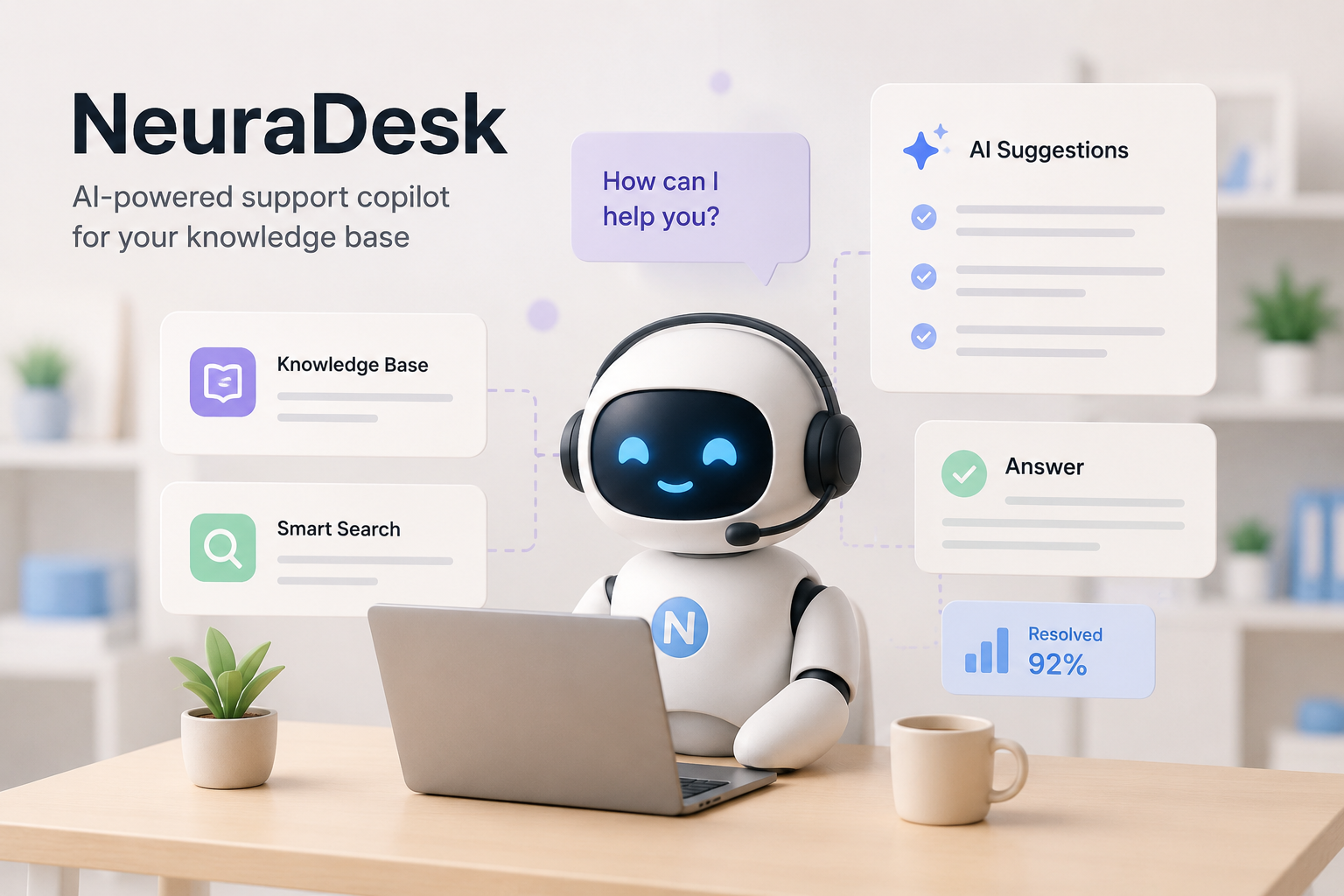
NeuraDesk
A retrieval-augmented support copilot that grounds answers in a company's own knowledge base.
Read Case Study →Why teams pick us for fine-tuning
ML engineers who've trained, evaluated, and served models past the demo stage.
Learn more about us →Honest about when to skip fine-tuning
We'll tell you when better retrieval, prompting, or model choice will get there faster and cheaper.
Data work treated as first-class
Dataset curation gets the same rigor as training — that's where most of the quality actually comes from.
Evaluation you can trust
Task-specific evals plus general capability checks so you don't ship a model that's better at one task and worse at everything else.
Own your stack — no vendor lock-in
Weights, datasets, and training code live in your accounts. You can retrain, swap base models, or self-host from day one.
Fine-tuning questions we hear most
Practical answers on when fine-tuning is worth it and how we approach it.
Which base model should we start from?
How much data do we actually need?
LoRA / QLoRA or full fine-tuning?
How do you evaluate a fine-tuned model?
What does GPU cost look like?
Can we host it on-prem?
Ready to fine-tune a model that fits?
Tell us the task and the constraints. We'll come back with a base model, a dataset plan, and a realistic budget.
Book a Discovery Session →